


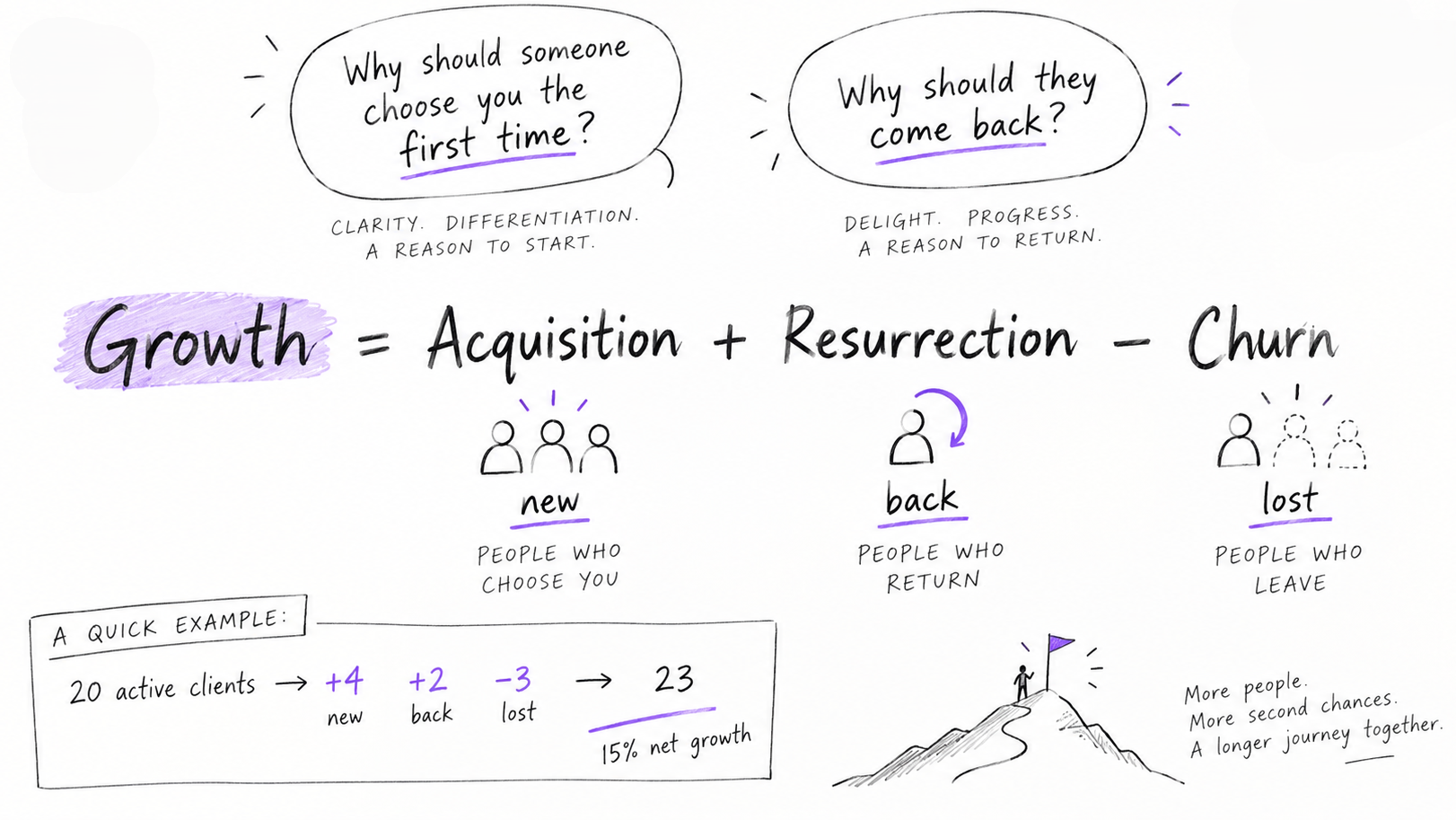
I have spent years working on growth. Early on, I didn’t even know to call it that. It’s easy to get lost in the language of awareness, conversion, virality, loyalty, yada yada….. But strip it all down, and growth starts with two questions.
1. Why should someone choose you for the first time?
2. Why should they come back?
The first question is about acquisition. The second is about retention.
Whether you’re building an app used by millions or running a coaching practice with 20 clients, these are the two fundamental questions you need to answer.
And sometimes, getting someone to come back means winning them over all over again.
Growth, deconstructed
A friend’s daughter just started kindergarten and is very much into number sentences. Growth has one too:
Growth = Acquisition + Resurrection − Churn
Here’s what each term means:
Acquisition: New customers who start working with you.
Resurrection: Former customers who return after being inactive.
Churn: Existing customers who stop working with you.
For example, say you start the month with 20 active clients.
You acquire 4 new clients, 2 former clients return, and 3 existing clients leave.
You end the month with 23 active clients. That’s 3 additional clients, or 15% net growth. Not bad!
Couple of things to notice:
You can grow without acquiring a single new customer.
And you can acquire plenty of new customers while your business is actually shrinking.
This is why looking only at new leads or new customers gives you an incomplete picture.
A small technicality: this equation measures the change in active customers. The broader principles apply to revenue, usage, or whatever growth means for your business. More on that another day.
Measure growth, not just activity
You don’t need fancy analytics to start. A spreadsheet is enough. The trick is to maintain it, but that’s a different post.
Track your active customers, new customers, returning customers, and churned customers every month.
Then look at the trends:
Month over month (MoM): Are you growing compared to last month?
Quarter over quarter (QoQ): Is growth improving over a longer period?
Year over year (YoY): Are you building a meaningfully larger business than you had a year ago?
A few practical details matter. Define what an active customer means for your business, and use that definition consistently. For a coach, it might be someone with an ongoing engagement. For a consultant, it might be someone with an active project. This can snowball into something complex quickly, so bias towards simplicity and the reality of your business.
Where to focus next
Once you start measuring these numbers, you’ll begin to see where your growth opportunities are.
If acquisition is weak, ask why more people aren’t choosing you.
If churn is high, ask why people aren’t staying.
If former clients rarely return, ask whether you’re giving them a reason to reconnect.
You don’t have to fix everything at once. Find the biggest opportunity and work on it.
Growth isn’t just about finding more customers. It’s about giving people a reason to choose you, stay with you, and choose you again.
That’s Growth 101.